History of Discovery
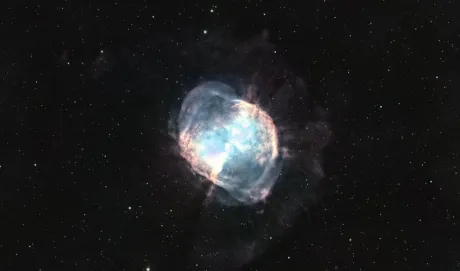
The Dumbbell Nebula, discovered by French astronomer Charles Messier in 1764, became the first known planetary nebula. Its name derives from its distinctive shape resembling a dumbbell. The object is located in the constellation of the Fox, approximately 1360 light-years from Earth.
Characteristics of the Nebula
The nebula is a massive cloud of heated gas formed after a dying star expelled its outer layers. Such objects are vital for studying the final stages of stars similar to the Sun. Over time, the central star of these nebulae transforms into a white dwarf.
Significance for Science
The image, captured using the TAL-200K telescope, was created from a series of frames with a total exposure of 10 hours. This image allows astronomers to analyze the nebula's structure and processes in detail, contributing to the understanding of stellar and cosmic object evolution.